
Monday, September 26, 2011


Some more Sonny Rollins news

From the blog post by critic Richard Scheinin of the San Jose Mercury News:
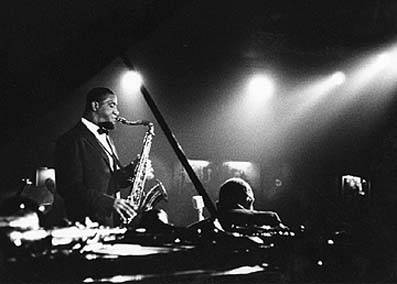
The festival is over. Sonny Rollins just played a two-hour set. He is 81 years old and an amazing man, an ORIGINAL man. He is the human bellows who baffles. He blows and blows and blows, saunters to the front of the stage with his tenor saxophone and honks, plays the blues, or holds REALLY long notes or imitates human speech with the craziest squiggles and smears. He never plays "Pent-up House" or "Dance of the Infidels," and he never will again. He plays obscure tunes that were on the radio when he was 10, or two-chord modal anthems, or funky little ditties that he wrote the other day.
His music tonight was largely about rhythm — he's got two drummers, a conguero and a trap drummer. And it was about his sound, cutting through that rhythm. He didn't pace the show well, sometimes wandered around playing riffs and bits of tunes, listening to his sidemen. It was odd, but it happens like this with Rollins. You hang in with him, watching and listening as he pursues his sound: massive and thick, carnivalesque, celebratory. He's an avant-garde populist; he should be leading a street parade.
And at the end of the two hours, that's what he was doing, in a way. He started playing "Don't Stop the Carnival" and the infectiousness of what he'd been pursuing all night kicked in. The crowd got on its feet and danced, cheering for Sonny as Sonny cheered for them with his saxophone. Monterey had ended.
Sunday, September 25, 2011


Saturday, September 24, 2011
ROIO Of The Week : Wall To Wall Miles Davis Tribute
Here's the second installment of the Wall to Wall Miles Davis Tribute in 2001.
Links are at the usual place.
Enjoy!

Wall to Wall Miles Davis
2001-03-24
Symphony Space, New York, NY.
FM Broadcast
A Quality
cdr in trade--eac--flac level 6
Disc 3:
Urban Tap/Aura - Tamango (tap dancer) & Fabio Morgera (tp)
1. 0:26 Intro
2. 2:11
3. 3:50
Gemini: Double Image - Burnt Sugar/The Arkestra Chamber
4. 16:03
5. 8:46
Directions in New Music - Dave Douglas New Quintet
w/ Dave Douglas (tp), Antonio Hart (alto sax), Uri Caine (el. p), James Genus (b), Calrence Penn (d)
6. 12:37
Loose Change from The Plugged Nickel - Ingrid Jensen Group
w/ Ingrid Jensen (tp), Gary Thomas (tenor sax), Orrin Evans (keys), Ed Howard (b), Jeff "Tain" Watts (d)
7. 3:04
8. 19:27 "Walkin'" (Miles Davis) Set II
Disc 4:
Pop Songs - Russell Gunn Group
w/ Carl Burnett (g), Marc Cary (p), Taurus Mateen (b), Terreon Gully (d)
1. 8:37 "Love For Sale" (Cole Porter)
2. 6:32 "Time After Time" (Cyndi Lauper)
He Loved Him Madly - Frank London & Invocations
w/ Frank London (tp), Anthony Coleman (organ), Ken Filiano
3. 12:27 "He Loved Him Madly" (Miles Davis memorial for Duke Ellington)
When Miles Split! - Adazaki Shangay (sp?)
4. 8:34 "When Miles Split!" (read by Amiri Baraka at Miles' memorial service, St. Peters Church, NYC)
The Birth of the Cool - Graham Haynes Nonet
5. 6:10 "Jeru"
6. 3:57 "Rouge"
7. 3:56 "Moon Dreams"
8. 4:16 "Venus De Milo"
9. 5:34 "Deception"
Sketches of Spain outtakes (never before heard)
10. 2:54
Reminiscences - George Avakian (Producer of Miles Ahead)
11. 14:27
Links are at the usual place.
Enjoy!
Wall to Wall Miles Davis
2001-03-24
Symphony Space, New York, NY.
FM Broadcast
A Quality
cdr in trade--eac--flac level 6
Disc 3:
Urban Tap/Aura - Tamango (tap dancer) & Fabio Morgera (tp)
1. 0:26 Intro
2. 2:11
3. 3:50
Gemini: Double Image - Burnt Sugar/The Arkestra Chamber
4. 16:03
5. 8:46
Directions in New Music - Dave Douglas New Quintet
w/ Dave Douglas (tp), Antonio Hart (alto sax), Uri Caine (el. p), James Genus (b), Calrence Penn (d)
6. 12:37
Loose Change from The Plugged Nickel - Ingrid Jensen Group
w/ Ingrid Jensen (tp), Gary Thomas (tenor sax), Orrin Evans (keys), Ed Howard (b), Jeff "Tain" Watts (d)
7. 3:04
8. 19:27 "Walkin'" (Miles Davis) Set II
Disc 4:
Pop Songs - Russell Gunn Group
w/ Carl Burnett (g), Marc Cary (p), Taurus Mateen (b), Terreon Gully (d)
1. 8:37 "Love For Sale" (Cole Porter)
2. 6:32 "Time After Time" (Cyndi Lauper)
He Loved Him Madly - Frank London & Invocations
w/ Frank London (tp), Anthony Coleman (organ), Ken Filiano
3. 12:27 "He Loved Him Madly" (Miles Davis memorial for Duke Ellington)
When Miles Split! - Adazaki Shangay (sp?)
4. 8:34 "When Miles Split!" (read by Amiri Baraka at Miles' memorial service, St. Peters Church, NYC)
The Birth of the Cool - Graham Haynes Nonet
5. 6:10 "Jeru"
6. 3:57 "Rouge"
7. 3:56 "Moon Dreams"
8. 4:16 "Venus De Milo"
9. 5:34 "Deception"
Sketches of Spain outtakes (never before heard)
10. 2:54
Reminiscences - George Avakian (Producer of Miles Ahead)
11. 14:27
Thursday, September 22, 2011
Miles Davis Documentary
This evening the special week concerning the 20th anniversary of Mile's passing starts of with a brand new documentary which will be shown on the french tv channel 'Tout l'histoire'. It starts at 20.35 and runs for 55 minutes.
More info on the docu made by Marjory Déjardin is available in this article :

More info on the docu made by Marjory Déjardin is available in this article :

TuneUp Update
The Tune Up redaction has been quite busy lately and we hope you like the updates posted here recently.
We will try to update the special created pages as well the coming days and weeks. The Monk and Eager one were already in use and we installed some details with cover art on a recent Miles Tribute. Please check them out in the near future.
We will also probably make some new special dedicated pages available as well.
If you want to contribute to Tune Up, you're always welcome to contact us.
Thanks in advance!
Wednesday, September 21, 2011

Tuesday, September 20, 2011
Sonny Rollins : Road Show Vol. 2 reviews
Volume 2 of Sonny Rollins's Road shows series will arrive shortly and we can read read some reviews of the album. TuneUp presents you three reviews :

By Dan Bilawsky
Published: September 7, 2011
Road Shows, Vol. 1 (Doxy, 2008) was the cure for all that ailed Sonny Rollins fans who were familiar with his herculean abilities in live settings, yet disappointed with some of his studio output. Famous for being his own worst critic, the tenor saxophonist cherry-picked all of the material for that outing, meeting near-universal acclaim upon its release. Now, three years later, Rollins returns with his highly anticipated sequel.
Road Shows, Vol. 2 adheres to the same basic principle, with Rollins putting his stamp of approval on live material that meets his exceptionally high standards, but differs when it comes to timeframe consistency. The performances on Road Shows, Vol. 1 spanned more than a quarter of a century, making it come off more like a sampler than a proper album, and providing fodder for those looking to find something about which to complain; a minor issue that is rectified on Vol. 2. The six tracks that make up this album were recorded within the span of one month, helping to unify its overall aural picture: four tracks were taken from Rollins' now-famous 80th birthday concert at New York's Beacon Theatre on September 10, 2010; the other two, from different shows in Japan the following month.
The Japanese selections bookend the album—a measly sub-three-minute "St. Thomas" sign-off at the end, and a lengthy, swinging "They Say It's Wonderful" at the top—but the real meat-and-potatoes comes in the four numbers Beacon Theatre numbers. On the first of these pieces, Rollins cedes the stage to Jim Hall—his guitar buddy from The Bridge (Bluebird, 1962)—for a short trip through "In A Sentimental Mood," but he makes up for lost time when Hall leaves, the saxophonist'
Road Shows, Vol. 2 serves as a reminder of all that's possible when everything is in its right place for a master musician, playing in the moment. This is firm evidence that the Saxophone Colossus still towers above tenors everywhere.
Track Listing: They Say It's Wonderful; In A Sentimental Mood; Sonnymoon For Two; I Can't Get Started; Rain Check; St. Thomas.
Personnel: Sonny Rollins: tenor saxophone; Jim Hall: guitar: (2); Russell Malone: guitar: (1, 3-5); Kobie Watkins: drums: 1, 2, 4-6); Bob Cranshaw: bass (1, 2, 4-6); Sammy Figueroa: percussion: (1,2, 4-6); Ornette Coleman: alto saxophone (3); Christian McBride: bass (3); Roy Haynes: drums (3); Roy Hargrove: trumpet (4, 5).
Music Review: 'Road Shows, Vol. 2' makes jazz history with first-time Rollins-Coleman pairing
By Charles J. Gans, The Associated Press
Tenor saxophonist Sonny Rollins remains an irresistible force of nature who's best heard in live concert settings where his exuberant, impassioned solos can blow an audience away. "Road Shows, Vol. 2" — which consists of tracks recorded at concerts in Japan and from Rollins' September 2010 80th birthday concert in New York — finds the jazz legend upping his game, pushed by guest soloists, trumpeter Roy Hargrove and alto saxophonist and free jazz visionary Ornette Coleman.
Rollins uses a familiar standard as a launching pad for his elongated, inventive improvisations on the opening track, an uptempo version of Irving Berlin's "They Say It's Wonderful." He's supported by one of his tightest touring bands of recent years, trading licks with the young drummer Kobie Watkins and guitarist Russell Malone. Rollins sits out the next track, a subdued take on "In a Sentimental Mood," performed by guitarist Jim Hall, his partner on the 1962 album, "The Bridge."
The album's centerpiece is the nearly 22-minute blues "Sonnymoon For Two," marking the first time longtime friends Rollins and Coleman have performed together in public. It begins with Rollins stretching out with bassist Christian McBride and fellow octogenarian, drummer Roy Haynes, in the piano-less trio format the saxophonist favoured on some of his classic, late 1950s albums. Coleman makes his unannounced entrance just under the nine-minute mark, launching into one of his abstract solos with asymmetric melodic phrases, yet rooted in the blues. As they trade solos, Rollins' playing goes more outside, until they climax in a frenzied unison outburst.
Hargrove and Rollins cool things down by embracing the lush ballad "I Can't Get Started," but then engage in some spirited call-and-response on Billy Strayhorn's "Rain Check." An abbreviated version of Rollins' joyful calypso "St. Thomas" provides an encore.
Unlike "Road Shows, Vol. 1" (2008), which offered live performances spanning 1980 to 2007, Rollins has blended together an more cohesive sequel from concerts recorded a month apart that show why he remains the "Saxophone Colossus."

Rollins' latest 'Road Shows' displays his sax mastery
By Bob Karlovits, PITTSBURGH TRIBUNE-REVIEW
Sonny Rollins still is the saxophone colossus his 1956 album said he was. Even in the face of such stars as Joe Lovano, Rollins wins polls and surveys and demands the respect as the master of his instrument. "Road Shows Vol. 2" is a compilation of live recordings that displays his unerring ability and individual tone that has made him so famous. Two of the tracks are from shows in Japan, while the other four, including a 21-minute "Sonnymoon for Two," are from his 80th birthday concert at New York City's Beacon Theater in 2010. The Beacon tracks feature guest appearances by guitarist Jim Hall, sax colleague Ornette Coleman, bassist Christian McBride and trumpeter Roy Hargrove on two of them. They also feature comments from Rollins that show his spirit and sense of humor. The most remarkable aspect of the album is how Rollins and his team give each of the six well-worn tunes a new life.
By Dan Bilawsky
Published: September 7, 2011
Road Shows, Vol. 1 (Doxy, 2008) was the cure for all that ailed Sonny Rollins fans who were familiar with his herculean abilities in live settings, yet disappointed with some of his studio output. Famous for being his own worst critic, the tenor saxophonist cherry-picked all of the material for that outing, meeting near-universal acclaim upon its release. Now, three years later, Rollins returns with his highly anticipated sequel.
Road Shows, Vol. 2 adheres to the same basic principle, with Rollins putting his stamp of approval on live material that meets his exceptionally high standards, but differs when it comes to timeframe consistency. The performances on Road Shows, Vol. 1 spanned more than a quarter of a century, making it come off more like a sampler than a proper album, and providing fodder for those looking to find something about which to complain; a minor issue that is rectified on Vol. 2. The six tracks that make up this album were recorded within the span of one month, helping to unify its overall aural picture: four tracks were taken from Rollins' now-famous 80th birthday concert at New York's Beacon Theatre on September 10, 2010; the other two, from different shows in Japan the following month.
The Japanese selections bookend the album—a measly sub-three-minute "St. Thomas" sign-off at the end, and a lengthy, swinging "They Say It's Wonderful" at the top—but the real meat-and-potatoes comes in the four numbers Beacon Theatre numbers. On the first of these pieces, Rollins cedes the stage to Jim Hall—his guitar buddy from The Bridge (Bluebird, 1962)—for a short trip through "In A Sentimental Mood," but he makes up for lost time when Hall leaves, the saxophonist'
Road Shows, Vol. 2 serves as a reminder of all that's possible when everything is in its right place for a master musician, playing in the moment. This is firm evidence that the Saxophone Colossus still towers above tenors everywhere.
Track Listing: They Say It's Wonderful; In A Sentimental Mood; Sonnymoon For Two; I Can't Get Started; Rain Check; St. Thomas.
Personnel: Sonny Rollins: tenor saxophone; Jim Hall: guitar: (2); Russell Malone: guitar: (1, 3-5); Kobie Watkins: drums: 1, 2, 4-6); Bob Cranshaw: bass (1, 2, 4-6); Sammy Figueroa: percussion: (1,2, 4-6); Ornette Coleman: alto saxophone (3); Christian McBride: bass (3); Roy Haynes: drums (3); Roy Hargrove: trumpet (4, 5).
Music Review: 'Road Shows, Vol. 2' makes jazz history with first-time Rollins-Coleman pairing
By Charles J. Gans, The Associated Press
Tenor saxophonist Sonny Rollins remains an irresistible force of nature who's best heard in live concert settings where his exuberant, impassioned solos can blow an audience away. "Road Shows, Vol. 2" — which consists of tracks recorded at concerts in Japan and from Rollins' September 2010 80th birthday concert in New York — finds the jazz legend upping his game, pushed by guest soloists, trumpeter Roy Hargrove and alto saxophonist and free jazz visionary Ornette Coleman.
Rollins uses a familiar standard as a launching pad for his elongated, inventive improvisations on the opening track, an uptempo version of Irving Berlin's "They Say It's Wonderful." He's supported by one of his tightest touring bands of recent years, trading licks with the young drummer Kobie Watkins and guitarist Russell Malone. Rollins sits out the next track, a subdued take on "In a Sentimental Mood," performed by guitarist Jim Hall, his partner on the 1962 album, "The Bridge."
The album's centerpiece is the nearly 22-minute blues "Sonnymoon For Two," marking the first time longtime friends Rollins and Coleman have performed together in public. It begins with Rollins stretching out with bassist Christian McBride and fellow octogenarian, drummer Roy Haynes, in the piano-less trio format the saxophonist favoured on some of his classic, late 1950s albums. Coleman makes his unannounced entrance just under the nine-minute mark, launching into one of his abstract solos with asymmetric melodic phrases, yet rooted in the blues. As they trade solos, Rollins' playing goes more outside, until they climax in a frenzied unison outburst.
Hargrove and Rollins cool things down by embracing the lush ballad "I Can't Get Started," but then engage in some spirited call-and-response on Billy Strayhorn's "Rain Check." An abbreviated version of Rollins' joyful calypso "St. Thomas" provides an encore.
Unlike "Road Shows, Vol. 1" (2008), which offered live performances spanning 1980 to 2007, Rollins has blended together an more cohesive sequel from concerts recorded a month apart that show why he remains the "Saxophone Colossus."
Rollins' latest 'Road Shows' displays his sax mastery
By Bob Karlovits, PITTSBURGH TRIBUNE-REVIEW
Sonny Rollins still is the saxophone colossus his 1956 album said he was. Even in the face of such stars as Joe Lovano, Rollins wins polls and surveys and demands the respect as the master of his instrument. "Road Shows Vol. 2" is a compilation of live recordings that displays his unerring ability and individual tone that has made him so famous. Two of the tracks are from shows in Japan, while the other four, including a 21-minute "Sonnymoon for Two," are from his 80th birthday concert at New York City's Beacon Theater in 2010. The Beacon tracks feature guest appearances by guitarist Jim Hall, sax colleague Ornette Coleman, bassist Christian McBride and trumpeter Roy Hargrove on two of them. They also feature comments from Rollins that show his spirit and sense of humor. The most remarkable aspect of the album is how Rollins and his team give each of the six well-worn tunes a new life.
Monday, September 19, 2011
Kennedy Center honors Sonny Rollins
Got this article in the mailbox a few days ago :

Kennedy Center Honors for Sonny Rollins!!
by Jacqueline TrescottWashington Post, September 7, 2011
The 2011 Kennedy Center Honors, announced Wednesday, salutes four architects of music -- from the improvisational saxophone of Sonny Rollins to the Broadway warmth of Barbara Cook, the tender cello of Yo-Yo Ma and the pulsing anthems of Neil Diamond.
The center has also selected actor Meryl Streep, who has sung in a few movies but is much better known for her flawless interpretations of characters over the past 30 years.
When the letters from the Kennedy Center arrive, even artists who have been in the spotlight for decades are a little taken aback. "I couldn't believe it but it actually said I was chosen as one of the Kennedy Center Honorees," said Diamond in a phone interview. "And it told me to keep my mouth shut." Now Diamond, 70, a native of Brooklyn, N.Y., can tell his mother, who is in her 90s and attends most of his concerts.
The Honors are given the first weekend of December in ceremonies at the State Department and the White House with an evening of all-star salutes to the Honorees, hosted by Caroline Kennedy at the Kennedy Center.
"You can look at the people chosen this year, and this is the 34th year and say arguably they are the best at what they do," said George Stevens, Jr., the co-producer of the Honors show.
...
Sonny Rollins
Rollins, who celebrates his 81st birthday Wednesday, has contributed so much to jazz that people for years have bypassed the adjective of "giant" and simply called him "a colossus."
Rollins, a native of Harlem, originally played alto sax and then switched to tenor sax. He emerged as a coveted sideman in the 1950s, playing with Miles Davis, Thelonious Monk, Art Farmer, Clifford Brown, Max Roach among others. In 1953, his recording "Sonny Rollins and the Modern Jazz Quartet" became a
classic. Other landmark albums followed, including "A Night at the Village Vanguard" in 1957 and "Freedom Suite" in 1958. In 2000, he won his first Grammy, for "This Is What I Do," and his second Grammy in 2004 for "Without a Song: The 9/11 Concert."
In a phone interview Rollins said the award honors more than just him. "I think that jazz has been sort of underrepresented in our culture. It is so gratifying to know that now it is beginning to be recognized as the great world force it is. I have fans in Mongolia, as well as Madison, Wisc.," said Rollins. "It is not about me but the idiom, and I am just one of the last guys standing."
Earlier this year, Rollins was awarded the National Medal of Arts. "I still practice every day. I am working hard to become more perfect in my art and presentation," he said.
...
Sunday, September 18, 2011

Saturday, September 17, 2011
The Monk Jazz competition
Here is Ben
Ratliff's piece on the Monk Jazz Piano competition.
---------------------------------------------------
September 13, 2011 New York Times
At Monk Competition, a Sound Worth Returning To
By
<http://topics.nytimes.com/
dex.html?inline=nyt-per> BEN RATLIFF
WASHINGTON - Hod Moshonov, a 22-year-old pianist from Israel, had already
loosened his tie by 1 p.m. on Sunday, and his wine-colored dress shirt was
coming loose from his waist. Super-revved, he seemed to dump his whole
conception of jazz on his instrument.
He leaned into the grand piano and damped the strings, playing muted
percussive melodies with his right hand alone. Then some classical Romantic
fantasias, leading into aggressive versions of Thelonious Monk's "Think of
One" and Freddie Hubbard's "Birdlike." He sang along to his rhapsodic
improvising and beatboxed against his rhythms. It was an exhausting 10
minutes.
Mr. Moshonov was the first of 12 to compete in the
<http://www.monkinstitute.org/
Monk International Jazz Piano Competition here on Sunday, presented by the
Thelonious Monk Institute of Jazz. Despite his abundant talent, he was the
first to fall. He did not make the finals. Kris Bowers, 22, from Los Angeles
but now a New Yorker, played a little after the halfway point on Sunday, and
the next day he won the $25,000 first prize.
What did Mr. Bowers have that the judges wanted? Polish, understatement,
breadth. He made the piano sound clear and pleasing, and he got along with
the rhythm section. He played "The Summer Knows," from Michel Legrand's
"Summer of '42" soundtrack, and then turned "Blue Monk" three ways:
reharmonized, stride-style and as a stomping shuffle. It was the only time
all afternoon that the audience started to clap and shout.
Aside from the imposing panel of judges - Herbie Hancock, Ellis Marsalis,
Danilo Pérez, Renee Rosnes, and Jason Moran - Aretha Franklin was sitting in
the auditorium at the Smithsonian Institution's National Museum of Natural
History. (She would be awarded the Monk Institute's Maria Fisher Founder's
Award, and sing in the gala concert on Monday night at the Kennedy Center
for the Performing Arts.) She sought out Mr. Bowers backstage, got his
telephone number and suggested they work together. She told him that "Summer
of '42" meant a lot to her because she was born that year.
The Monk competitions are many things: thrilling, strange, boring. Musicians
play unaccompanied and with a trio, with one Monk tune required. The process
can become an unsolvable puzzle. It is a performance, an occasion to
demonstrate presence of mind, but for each contestant it is also a canned
and unnatural 10 minutes. You must be memorable, but you can't overdo it.
Most people agree that jazz lives on originality, but you must prove
yourself a proper custodian of the past. You want to create immediate
gratification, but the implication of the first prize is that you'll be a
responsible bandleader, carrying jazz forward.
The event - the most visible part of the institute's educational initiative,
which includes high school programs and a tuition-free master's program at
U.C.L.A. for eight students at a time - began 25 years ago, in 1986. At
first it was piano-only, and soon the featured instrument began to change
each year. This was the seventh piano competition; winners have included
Marcus Roberts, Jacky Terrasson and Eric Lewis. Winning first prize does not
guarantee fame, but it helps, especially at a time when many jazz
bandleaders do their own publicity via Twitter, and a deal with Concord
Records, a label with a publicity department, comes with it.
The two-year master's program has yielded visible results. New York jazz
aficionados will have noticed a clump of excellent performers who all seem
to play in other people's bands: Gerald Clayton, Joe Sanders, Ambrose
Akinmusire, Walter Smith III, Chris Dingman. What they have in common is
their recent involvement with the Monk Institute.
Pianists do it all: they're leaders, composers, rhythm-section players and
unaccompanied soloists. In this Monk competition some pianists created a
sleek and battened-down European mood, as if auditioning for ECM Records;
they weren't so interested in the feeling of swing. Most of the solos were
built of prefabricated lines and licks, without much melodic improvisation.
Few pianists accompanied a bass or drum solo; they just shut down for a
little while. And some were nervously overeager to show how good they were
with tricky rhythmic patterns: perhaps that's why Monk's "Evidence," with
its unusual pattern of rests, like potholes in a road, was presented three
times.
Emmet Cohen, a senior at the University of Miami, placed third on Monday,
and one of the competition's most memorable musicians came in second. Joshua
White, 26, from San Diego, had one overriding style: he embedded a song in
thick, unbroken clumps of chords. He pressed hard against the rhythm section
and improvised with form, telling the bassist Rodney Whitaker and the
drummer Carl Allen what to do and when, accelerating and decelerating,
suddenly going free. (Nobody else did that.)
Mr. White used a lot of dissonance and clutter, but it was provocative,
chord-related clutter, not the brilliant-soloist kind made mostly with the
right hand. It was a sound worth returning to, one that had more to do with
Monk than that of the rest of the pianists - although emulating Monk per se
is not a competition requirement.
Ms. Franklin was the star of Monday's 25th-anniversary gala concert, the
most extreme and complicated example of an event that has historically
brought together a surreal mixture of inward improvisers, outward pop stars
and government officials.
Dozens of personages shuttled on and off stage. Among them were Colin L.
Powell and Madeleine K. Albright, who participated on the institute's
anniversary committee; executives from sponsors, including Cadillac,
Northrop Grumman and United Airlines, who all gave grandiloquent speeches;
former competitors, not all of them winners; Mr. Hancock and Wayne Shorter;
the "American Idol" star Jennifer Hudson, who sang "Oh Me Oh My (I'm a Fool
for You Baby)"; the rapper Doug E. Fresh; Chaka Khan, Dianne Reeves, Dee Dee
Bridgewater, Kurt Elling and Jane Monheit, who strung together a half-dozen
Franklin hits; and Ms. Franklin herself, who sang "Moody's Mood for Love,"
dramatically, with lots of cries and asides, dancing her way offstage,
letting a stagehand untangle a long, gauzy shoulder wrap from her microphone
cord.
Thursday, September 15, 2011

Wednesday, September 14, 2011
Sonny Clark

Apparently the author of the Jazz loft Project book, Sam Stephenson might work on and publish a Sonny Clark biography.
This blog entry mentions a rather long article which will be published in Tin House Magazine later this year and with earlier articles published at the Paris Review here and here he might consider publishing a book.
So there was a reason i listened at those Sonny Clarke recordings last week?
Tuesday, September 13, 2011
France Musique : Le Matin des musiciens

Since the end of august, the radio program 'Le Matin des Musiciens' dedicates its programs to jazz pianists. The first program of the season was dedicated to Gil Evans and was hosted by guest Laurent Cugny and last week Guillaume de Chassy introduced Keith Jarrett. Today (at 11.00 A.M. GMT+1) Laurent De Wilde will tell us about Thelonious Monk.

The program can be listened at online and is available as podcast or 30 days after its original broadcast. I recorded the first two programs and will in due time upload them as MP3...

Monday, September 12, 2011
Miles Davis - Live In Europe 1967

On the site of National Public Radio there's a short review but what's more one can listen at extracts of the set...
Enjoy!
Sunday, September 11, 2011
Graham Collier R.I.P.
God this sad news in the inbox this evening. Mr. Collier passed away saturday evening in Greece. read more about it here.
R.I.P. Mr. Collier
R.I.P. Mr. Collier


Saturday, September 10, 2011
Miles Davis - Live In Europe 1967

While i'm still waiting the arrival of the forthcoming box we can find already some reviews online as for example at the NYT.
Saturday, August 20, 2011
Stanley Kubrick and Waterloo and Napoleon
Got this in from a list i'm on, happy reading :
AUGUST 13, 2011
How Stanley Kubrick Met His Waterloo
By FREDERIC RAPHAEL
Whether for a novel, a history or a film, it requires a brave man to take on Napoleon Bonaparte. Tyrant or liberator, lawgiver or law-breaker, depending on how you look at him, Byron's "little pagod" remains, for his admirers, the incarnation of the romantic genius. Hegel, who saw him just once, hailed him—while he was still the unbeaten champion, headed to meet his nemesis in Russia—as an unmistakable "world-historical" figure, the personification of domineering panache.
From the earliest days of the cinema, filmmakers were drawn to his flame. Charlie Chaplin is said to have toyed with the subject as early as 1922. Around the same time, Abel Gance began but never finished a vast silent epic, full of symbolic juxtapositions and martial panoramas. Sacha Guitry made some sly chamber-pieces in the 1940s, in which he enjoyed standing in for the wily and witty Talleyrand, France's two-faced diplomat for all political climates.
In more recent years, Napoleon—impersonated by Marlon Brando, Rod Steiger, Herbert Lom, Woody Allen and others—has featured in a number of more or less colossal productions, none unsurpassable. The best of them, we are promised by Alison Castle, was going to be that of Stanley Kubrick. The massive, trilingual volume that is now to hand—you need two of them just to lift its 7½ pounds of text and pictures—contains Kubrick's script of the abortive project as well as samples of the research material he assembled over a period of years in the late 1960s and early 1970s. Much of the archive lay derelict after the early 1970s.
Kubrick himself is quoted saying that he was going to make "the greatest movie of all time." Since he was not a boastful man, we can assume that this was a blurb, composed on the principle of "promise them anything," to persuade his sponsors (MGM, then United Artists) to put the necessary gold in his war chest. No art form has ever demanded more money for its realization than the movies, and few have been imagined on a more epic scale than "Napoleon" (even if the budget was to be kept down by having extras wear cheap paper uniforms printed in New York).
As a creator, Kubrick always wanted to figure as what chess players (he carried himself as a grandmaster) call "Solus Rex": the only royal piece on the board. With "Napoleon," he intended to be writer, director and producer of his greatest achievement. This willful loneliness was alleviated only by enrolling the help of fact-finders and location spotters—in particular, Oxford historian Felix Markham, under whose tutelage he assembled a voluminous library cross-indexing details and images of everything and everyone that touched Napoleon's life.
Stanley Kubrick's 'Napoleon':The Greatest Movie Never Made
Edited by Alison Castle
Taschen, 1,112 pages, $49.99
The more material he perused, the more he thought he needed. Several pages here are devoted to why, when invading Russia, the usually far-sighted Napoleon failed to be sure that his farriers were equipped with frost-resistant horseshoes. As a result, his cavalry, and his supply train, were crippled by "General Winter." The protracted tape-recorded inquisition of Markham has only a few diverting moments—for instance, when Kubrick is quizzing the historian about Talleyrand and Napoleon's two-faced police chief, Fouché:
F.M.: Of course if Napoleon had won Waterloo, they'd have changed their tune pretty rapidly, I think.
S.K.: We should go to lunch.
When not hungry in the banal sense, Kubrick exhibited an appetite for learning that smacks of neurotic postponement. Flaubert was only the most famous writer to have made "research" a prolonged prelude to the dreaded moment when he had to face the blank page. Kubrick's principal difficulty was that he had almost no French and, it seems, little sense of France. (It had not hampered him when he made "Paths of Glory" because Calder Willingham had supplied his French officers and men with a nicely stylized, but playable, form of words.) The idea that the Corsicans were "like the Scottish highlanders" among the English—that is, a marginal but virile people—led to the daft notion that Napoleon might be acted with a Scottish accent.
In Kubrick's script, one of his generals pours Napoleon a "whisky," which seems as improbable as his request to Josephine, when he first meets his femme fatale, for a "sherry." It is odd that Napoleon at one point is said to look at his "wristwatch" (a 20th-century invention). There is also an anachronistic "teddy bear," Napoleon's alleged childhood toy, which his mother Letizia tidies away at the end of the film. It looks like hommage to "Rosebud," the sleigh that begins and ends Orson Welles's "Citizen Kane." On the other hand, the real Letizia's great line, when she heard of her son's coronation, "Pourvu que ça dure!" ("as long as it lasts!"), finds no place here.
Jan Harlan (Kubrick's executive producer and brother-in-law) says, quite rightly, that Kubrick "tried all genres" and "never repeated himself." What he does not say is that his desire to be a unique creator was always frustrated: His movies were never independent of someone else's source material. The triumphs that armed him to attack "Napoleon" were indebted, however grudgingly, to Terry Southern ("Dr. Strangelove"
The most poignant document is on page 616 in this 1,112-page tome. It is on yellow paper in Kubrick's own disjunctive script:
Problems
1. Who is Napoleon?
2. English.
3. How does N talk?
4.
The answers given in the script to questions 2 and 3 do not suggest that Kubrick ever licked the problem. Here is Napoleon's response to the news of Josephine's death: "She was the most alluring, most glamorous creature I have ever known—a woman in every sense of the word. " Try not to get an unwanted laugh with a line like that. Later, Napoleon tells the defeated Austrian emperor: ". . . the first rule of warfare. You must wear long-sleeved and long-legged underwear. You can never conjure up brilliancies with a cold bottom." True? Maybe. Funny?
The vacant fourth question has to have been how words and gestures could be attributed, plausibly, to characters Kubrick could visualize but could never inhabit: Crafting dialogue depends on a capacity to act like, and seem to be, other people. The "Napoleon" script might have been more daring, and convincing, if Kubrick had not fretted so much about authenticity.
For instance, there is a long scene devoted to the nuptial night of Napoleon with his virginal second wife, the 18-year-old, convent-educated Marie-Louise, daughter of that Austrian emperor (for whose benefit the middle-aged Master of the World took lessons in the waltz). Kubrick has them consummate the marriage on a darkened screen. He planned for us to hear only an assortment of giggles. It is possible that this could have delivered the required comedy, but it is said elsewhere that the young girl, far from wincing at her depucelage, immediately asked her somewhat spent husband, "Can we do it again?" Apocryphal or not, it rings true enough to pay off the scene better than giggles.
The historian Geoffrey Ellis, in one of the book's prefatory essays, claims that Kubrick's script "certainly deserve[s] its place in the company of other famous Napoleons; it is up to the reader to decide if it may or may not have surpassed them." My decision is that it did not. It was always going to be impossible to cram everything onto the screen. But why did he bother creating from whole cloth when, for instance, Vincent Cronin's one-volume life of Napoleon offered quite enough material on which to build an imaginative script?
Solus rex, Kubrick never cracked how best to dramatize his epic. All the effort that went into his "Napoleon" appears to have come to nothing, yet it did not. Kubrick did, in fact, come to make one of the greatest period movies of all time: "Barry Lyndon," for which William Makepeace Thackeray supplied the picaresque form, characters and much of the dialogue. The ironies so mordantly delivered by Michael Hordern, in the film's elegantly phrased voice-over, counterpointed the beauty of Stanley's immaculate staging. Kubrick was indeed a grandmaster; it is no shame, and certainly no blasphemy, to concede that Napoleon defeated him.
AUGUST 13, 2011
How Stanley Kubrick Met His Waterloo
By FREDERIC RAPHAEL
Whether for a novel, a history or a film, it requires a brave man to take on Napoleon Bonaparte. Tyrant or liberator, lawgiver or law-breaker, depending on how you look at him, Byron's "little pagod" remains, for his admirers, the incarnation of the romantic genius. Hegel, who saw him just once, hailed him—while he was still the unbeaten champion, headed to meet his nemesis in Russia—as an unmistakable "world-historical" figure, the personification of domineering panache.
From the earliest days of the cinema, filmmakers were drawn to his flame. Charlie Chaplin is said to have toyed with the subject as early as 1922. Around the same time, Abel Gance began but never finished a vast silent epic, full of symbolic juxtapositions and martial panoramas. Sacha Guitry made some sly chamber-pieces in the 1940s, in which he enjoyed standing in for the wily and witty Talleyrand, France's two-faced diplomat for all political climates.
In more recent years, Napoleon—impersonated by Marlon Brando, Rod Steiger, Herbert Lom, Woody Allen and others—has featured in a number of more or less colossal productions, none unsurpassable. The best of them, we are promised by Alison Castle, was going to be that of Stanley Kubrick. The massive, trilingual volume that is now to hand—you need two of them just to lift its 7½ pounds of text and pictures—contains Kubrick's script of the abortive project as well as samples of the research material he assembled over a period of years in the late 1960s and early 1970s. Much of the archive lay derelict after the early 1970s.
"Stanley Kubrick's 'Napoleon' " includes not only notes, drawings and photographs of potential costumes and scenes but records of the director's correspondence—
Alison Castle's task of editorial collation "without betraying Kubrick's intentions" is, she tells us, "either unrealistic or just plain blasphemous. . . . Yet, in the opinion of many, present company included, it would be bordering on criminal not to share this treasure trove with the world." This hagiographical obsequiousness suggests that we are to be conducted through a treasury of sacred relics. Only the existence of something like a cult, with its hierarchy of genuflecting acolytes, can account for using "blasphemous" to describe the publication—down to the last scribbled note and photographed paper clip—of the verbal and visual baggage assembled for an excursion that never happened.
Alison Castle's task of editorial collation "without betraying Kubrick's intentions" is, she tells us, "either unrealistic or just plain blasphemous. . . . Yet, in the opinion of many, present company included, it would be bordering on criminal not to share this treasure trove with the world." This hagiographical obsequiousness suggests that we are to be conducted through a treasury of sacred relics. Only the existence of something like a cult, with its hierarchy of genuflecting acolytes, can account for using "blasphemous" to describe the publication—down to the last scribbled note and photographed paper clip—of the verbal and visual baggage assembled for an excursion that never happened.
Kubrick himself is quoted saying that he was going to make "the greatest movie of all time." Since he was not a boastful man, we can assume that this was a blurb, composed on the principle of "promise them anything," to persuade his sponsors (MGM, then United Artists) to put the necessary gold in his war chest. No art form has ever demanded more money for its realization than the movies, and few have been imagined on a more epic scale than "Napoleon" (even if the budget was to be kept down by having extras wear cheap paper uniforms printed in New York).
As a creator, Kubrick always wanted to figure as what chess players (he carried himself as a grandmaster) call "Solus Rex": the only royal piece on the board. With "Napoleon," he intended to be writer, director and producer of his greatest achievement. This willful loneliness was alleviated only by enrolling the help of fact-finders and location spotters—in particular, Oxford historian Felix Markham, under whose tutelage he assembled a voluminous library cross-indexing details and images of everything and everyone that touched Napoleon's life.
Stanley Kubrick's 'Napoleon':The Greatest Movie Never Made
Edited by Alison Castle
Taschen, 1,112 pages, $49.99
The more material he perused, the more he thought he needed. Several pages here are devoted to why, when invading Russia, the usually far-sighted Napoleon failed to be sure that his farriers were equipped with frost-resistant horseshoes. As a result, his cavalry, and his supply train, were crippled by "General Winter." The protracted tape-recorded inquisition of Markham has only a few diverting moments—for instance, when Kubrick is quizzing the historian about Talleyrand and Napoleon's two-faced police chief, Fouché:
F.M.: Of course if Napoleon had won Waterloo, they'd have changed their tune pretty rapidly, I think.
S.K.: We should go to lunch.
When not hungry in the banal sense, Kubrick exhibited an appetite for learning that smacks of neurotic postponement. Flaubert was only the most famous writer to have made "research" a prolonged prelude to the dreaded moment when he had to face the blank page. Kubrick's principal difficulty was that he had almost no French and, it seems, little sense of France. (It had not hampered him when he made "Paths of Glory" because Calder Willingham had supplied his French officers and men with a nicely stylized, but playable, form of words.) The idea that the Corsicans were "like the Scottish highlanders" among the English—that is, a marginal but virile people—led to the daft notion that Napoleon might be acted with a Scottish accent.
In Kubrick's script, one of his generals pours Napoleon a "whisky," which seems as improbable as his request to Josephine, when he first meets his femme fatale, for a "sherry." It is odd that Napoleon at one point is said to look at his "wristwatch" (a 20th-century invention). There is also an anachronistic "teddy bear," Napoleon's alleged childhood toy, which his mother Letizia tidies away at the end of the film. It looks like hommage to "Rosebud," the sleigh that begins and ends Orson Welles's "Citizen Kane." On the other hand, the real Letizia's great line, when she heard of her son's coronation, "Pourvu que ça dure!" ("as long as it lasts!"), finds no place here.
Jan Harlan (Kubrick's executive producer and brother-in-law) says, quite rightly, that Kubrick "tried all genres" and "never repeated himself." What he does not say is that his desire to be a unique creator was always frustrated: His movies were never independent of someone else's source material. The triumphs that armed him to attack "Napoleon" were indebted, however grudgingly, to Terry Southern ("Dr. Strangelove"
The most poignant document is on page 616 in this 1,112-page tome. It is on yellow paper in Kubrick's own disjunctive script:
Problems
1. Who is Napoleon?
2. English.
3. How does N talk?
4.
The answers given in the script to questions 2 and 3 do not suggest that Kubrick ever licked the problem. Here is Napoleon's response to the news of Josephine's death: "She was the most alluring, most glamorous creature I have ever known—a woman in every sense of the word. " Try not to get an unwanted laugh with a line like that. Later, Napoleon tells the defeated Austrian emperor: ". . . the first rule of warfare. You must wear long-sleeved and long-legged underwear. You can never conjure up brilliancies with a cold bottom." True? Maybe. Funny?
The vacant fourth question has to have been how words and gestures could be attributed, plausibly, to characters Kubrick could visualize but could never inhabit: Crafting dialogue depends on a capacity to act like, and seem to be, other people. The "Napoleon" script might have been more daring, and convincing, if Kubrick had not fretted so much about authenticity.
For instance, there is a long scene devoted to the nuptial night of Napoleon with his virginal second wife, the 18-year-old, convent-educated Marie-Louise, daughter of that Austrian emperor (for whose benefit the middle-aged Master of the World took lessons in the waltz). Kubrick has them consummate the marriage on a darkened screen. He planned for us to hear only an assortment of giggles. It is possible that this could have delivered the required comedy, but it is said elsewhere that the young girl, far from wincing at her depucelage, immediately asked her somewhat spent husband, "Can we do it again?" Apocryphal or not, it rings true enough to pay off the scene better than giggles.
The historian Geoffrey Ellis, in one of the book's prefatory essays, claims that Kubrick's script "certainly deserve[s] its place in the company of other famous Napoleons; it is up to the reader to decide if it may or may not have surpassed them." My decision is that it did not. It was always going to be impossible to cram everything onto the screen. But why did he bother creating from whole cloth when, for instance, Vincent Cronin's one-volume life of Napoleon offered quite enough material on which to build an imaginative script?
Solus rex, Kubrick never cracked how best to dramatize his epic. All the effort that went into his "Napoleon" appears to have come to nothing, yet it did not. Kubrick did, in fact, come to make one of the greatest period movies of all time: "Barry Lyndon," for which William Makepeace Thackeray supplied the picaresque form, characters and much of the dialogue. The ironies so mordantly delivered by Michael Hordern, in the film's elegantly phrased voice-over, counterpointed the beauty of Stanley's immaculate staging. Kubrick was indeed a grandmaster; it is no shame, and certainly no blasphemy, to concede that Napoleon defeated him.
Friday, August 19, 2011
Two year Birthday
Tune Up in its actual form (that is on Blogger) exists now for two years. We want to thanks all visitors for passing by and we hope to see you as regular as in the past. We hope to publish more in the future and to pick up the track again of some ROIO's as well.
Anyway, you're always welcome at Tune Up !
Anyway, you're always welcome at Tune Up !
Subscribe to:
Posts (Atom)